
Field notes · 6 min read
Chasing squirrels
A walk in the woods with Riley, a Stoic line from a podcast, and a conversation with ChatGPT about living in accordance with reality. On accepting what's in front of you, and what nine years of watching my dog chase squirrels he'll never catch has taught me about the chase.
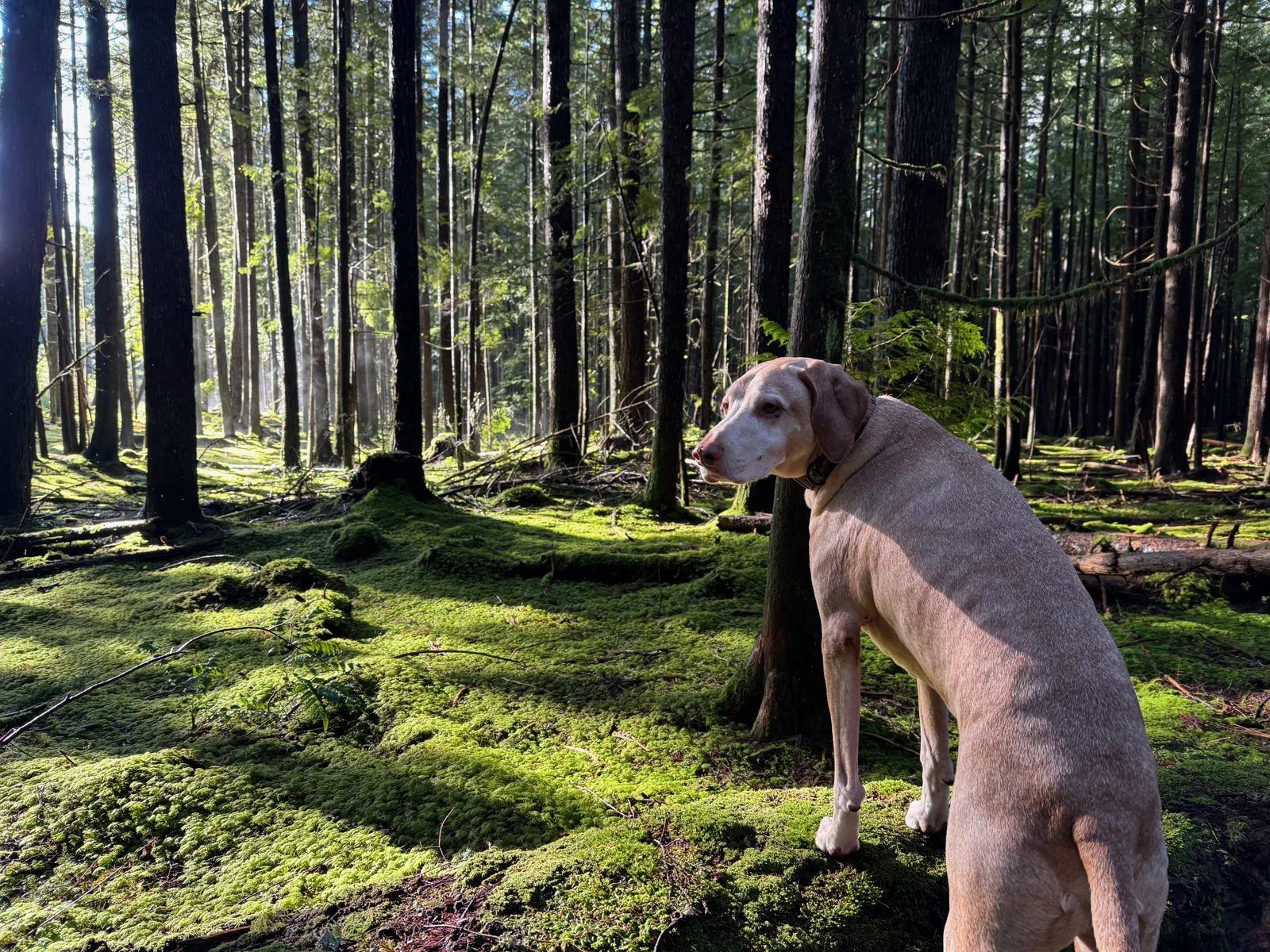
Riley and I were out at his favourite spot, a stretch of forest near home where the ground is a blanket of moss and ferns. It's beautiful. It also has terrible cell coverage, so my podcast wouldn't start, and I was standing on the trail staring at my phone, willing it to load.
Riley started barking at me. Not at a squirrel. At me.
You're right, I told him. I've been obsessing over Hangar, learning AI and looking for my next role so much lately that I've been neglecting him a bit. I put the phone away. Time for a little walking meditation, and a little squirrel hunting with my buddy.
The fabric of reality
A few moments later, a line from a podcast I'd heard a few days earlier popped into my head: live your life in accordance with the fabric of reality. It's a very Stoic idea, and it stuck with me because it describes how I already try to live. In my own words, it goes something like this:
Live in accordance with reality. Accept what is true in front of me. Spend no time judging or criticizing what I see, or looking for whom to blame. Instead, find the best path forward in light of what I see, not despite it.
That thought led to another thought, and I wanted to know what someone else thought of my thought. So, yes, not long after putting my phone away, I took it back out and typed it into ChatGPT. Riley was not impressed.
What came back
The conversation that followed was better than I expected, and a few ideas from it have stayed with me.
The first is that reality doesn't need your agreement to impose its consequences. You don't have to approve of what happened, like it, or think it's fair. You just have to see it accurately if you want to respond well. As ChatGPT put it, you don't have to win an argument with reality before you can get on with your life.
The second is what I'd call the second cost. When something goes wrong, the problem itself costs you something. Your reaction to it can cost you more: the hour spent being frustrated with whoever made the call, replaying how anyone could have missed it. Judging and blaming feel like progress, but mostly they're a way of revisiting a situation without changing it. Living in accordance with reality is, in part, refusing to pay that second cost.
That isn't the same as switching off judgment. Noticing that a system is broken, or that someone can't be trusted, is useful information. The trick is to stop getting stuck in the evaluation when there's something you could be doing instead.
The third is about where agency actually lives. ChatGPT laid out three ways to meet a hard situation, and I liked them enough to write them down:
- Passivity: things are the way they are, so there's nothing I can do.
- Denial: things are the way they are, but I'll act as if they aren't.
- Agency: things are the way they are. What can I do with that?
Acceptance isn't surrender. It's where useful action starts. A sailor doesn't demand that the wind blow from somewhere else; they read it and trim the sails.
It also pushed back on me a little, which I appreciated. Accepting that something is real isn't the same as accepting that it's right, or permanent. You can acknowledge that someone treated you badly and still set a boundary or walk away. And what I see isn't necessarily what is. I have blind spots like everyone else, so "accept what I see" only works if I'm willing to see more tomorrow and change course. It offered a neat way to hold the difference between blame and responsibility, too. Blame asks who deserves to be condemned for this. Responsibility asks what's mine to do about it now.
Nine years of squirrels
By then Riley was off the trail and deep in the ferns, after a squirrel. Which gave me another thought.
I've spent nine years watching Riley chase squirrels. He's only ever caught one. The squirrel should zigged when it zagged and ended up in the creek. Luck aside, he never really stands a chance. But he doesn't know that, and he's as excited about the chase today as he was the first time. Because it's all about the chase. Not the outcome.
I knew that thought connected to my first thought somehow. I typed that in too. I got a strong defense of Riley's squirrel chasing.
We all have our own squirrels: the job, the title, the number in the bank account, the recognition that will finally make the work feel like it mattered. The trap isn't chasing them. It's making the catch a condition for enjoying the walk, so that "I'll be happy when" becomes a way of judging today against a future that doesn't exist yet. There's always another squirrel.
Riley doesn't do that. He isn't postponing anything until he catches one. The chase is the whole point, and nine years of evidence hasn't made him cynical about it. He hasn't concluded that his time would be better spent on something with higher odds. Every squirrel is just another reason to run.
It was never about the catch. It's about the chase.
There was one line in that conversation I keep coming back to. "I can't catch the squirrel, so I might as well enjoy the chase" is resignation. "I enjoy the chase; catching the squirrel was never necessary" is freedom. They sound alike, but they're nothing alike.
So where does that leave my first thought, about living in accordance with reality? I think it means two things at once. See the world clearly enough not to fool yourself about what's possible, and be present enough not to miss what's already happening. A squirrel you can't catch is different from one you haven't caught yet, and part of the job is being honest about which one you're after. The rest is enjoying the run.
What I'm taking back to work
I build platforms, so of course I couldn't leave it in the forest. A lot of what I believe about the work is this same idea wearing a hard hat. A good incident review starts from what actually happened, not from who should have known better. A good platform starts from the systems a company really has, not the ones on the architecture slide. It's why I label everything on this site as built, draft or proposal, and why the gaps are written down in public. You can't find the best path forward from a place you're pretending to be.
And it's a fair description of this season of my life. Hangar, learning to build with AI, and the job search are all squirrels, and good ones. I'm going to keep chasing them with everything I've got. I'm just not going to make catching them the price of enjoying the walk.
Back on the trail
The squirrel got away, obviously. Riley came bounding back out of the ferns, covered in bits of moss and completely delighted with himself, and we kept walking. The podcast never did load. I didn't miss it.