
Architecture · 13 min read
The release record, and the users I haven't met
Tower's release record follows a release from its draft to its outcome and writes every decision into git. What it's trying to fix, how it works, and why I keep a release's story in the GitOps repo. And an honest admission: Hangar has no users, so every part of it rests on assumptions about customers I've never met. Here they are, with how I'd test each one.
The part of Hangar I'm fondest of right now is a YAML file. Every time one of the Skyport apps ships to
production, Tower opens a pull request that adds a file like
releases/flight-api@1.8.0-4f9c2ab.yaml to the app's GitOps repo. It says what changed, who wrote
the notes, who signed off, how the commit was proven, what the tests found, and, a week later, how it went.
Months from now I can open it and get the whole story of that release in one place, without a single tool
having to still be running.
I want to show it off. But I also want to be honest about something the feature makes hard to ignore. Nobody has used it but me.
Discovery, with nobody to discover
The first of my principles is that the platform is a product, and a product is shaped by the people who use it. In Why a platform still needs a service catalog I said I'd start any platform with discovery: fifteen or twenty interviews, a couple of onboardings shadowed end to end, and features that come out of what people actually said hurt.
Hangar doesn't get to do that. It's my lab. The Skyport apps are made up, and I play every part: the developer who merges, the release owner who writes the notes, the reviewer who signs off, the person on call when it goes wrong, and the auditor who turns up months later asking who approved what. Every feature in the release record is built on what I think those people need. That's a lot of assumptions, made as if I understood customers I've never met.
I don't think the answer is to stop building. A lab is where you can afford to be wrong. But I think the honest thing is to treat each feature the way a product team treats an idea before it has data: as a hypothesis, written down, with a way to find out if it's wrong. So that's how this essay goes. Here's the problem I believe the release record solves, how it works, and then the guesses underneath it, out in the open.
The problem: a release's story is everywhere
Ask a team what went out last Tuesday and how it went, and the answer usually lives in eight places. The pull
requests are in the forge. The builds were in the CI system until the runs were pruned. The approval is a
review on a PR nobody can find. The rollout state sat on a cluster until it was cleaned up. The change ticket
is in the change tool. The release notes were written the night before from git log, if they
were written at all. And how it went is in a chat thread, or in someone's head.
Each of those is fine on its own. Together they mean a release has no story, only scattered evidence. The questions people ask about a release are simple, though, and I think there are about six of them.
The left-hand column of that diagram is the first assumption. Those are the people I picture asking, and I've never asked them.
The first version was a receipt
Tower's first release record was written after the fact. Once a release was healthy in its first Flight environment, a poller opened a pull request with everything Tower knew about it, and people could add a summary, a risk level and approvals afterwards. When I sat in an app owner's seat for the second field report, release management was the part of Tower I trusted most.
But writing the lifecycle spec on October 13, 2026, I noticed the record showed up after every decision it could have informed. Scope had been gathered, notes written, a build picked and the go or no-go made, all before Tower wrote anything down. An approval added once a release is already healthy in production isn't really an approval. It's an acknowledgement. And the confidence score handed every release five points for "no incidents", because Tower had no way to record one.
So the record moved earlier and ended later. The four changes in that spec shipped in Tower v0.67 to v0.70 over the next two days. It's a small example of the loop I'm describing, with the only user I have: I used it, it was wrong in a way I could see, and I changed it.
How it works
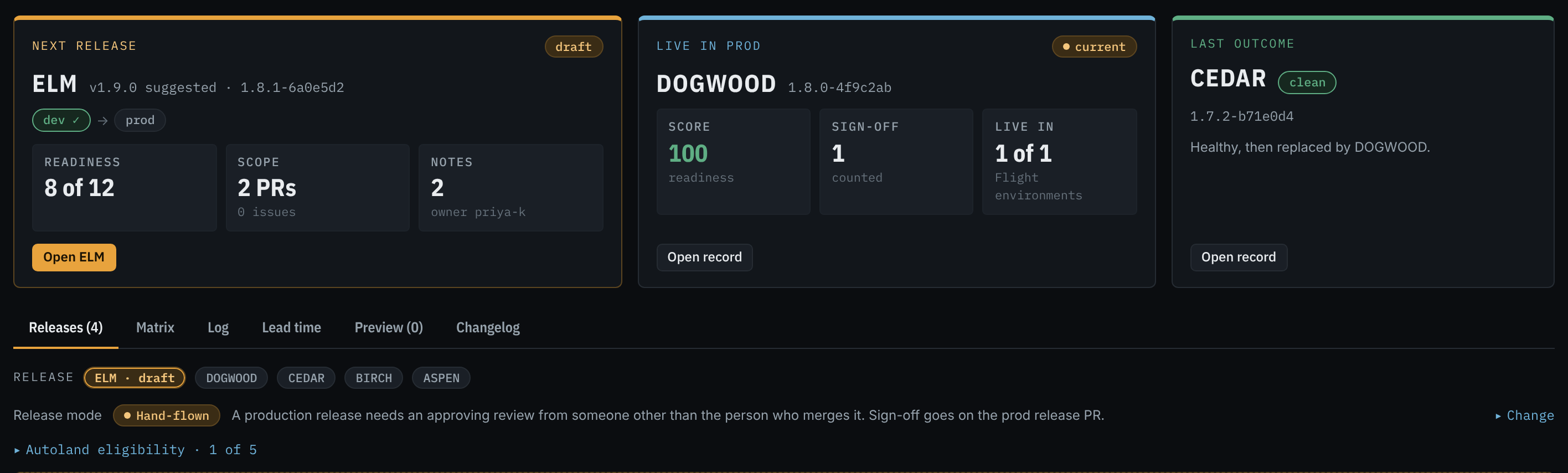
Follow one release of Skyport's flight-api. The moment its last release, DOGWOOD, reaches Flight, a draft for the next one exists. It's called ELM. Releases are named in order per app, the way hurricanes are, because "DOGWOOD, shipped as amber-heron" is easier to say in a standup than an image tag.
The draft builds itself. Its scope is every pull request merged to main since DOGWOOD's commit landed, with the issues they close. Open PRs show as incoming, not in scope, because no image contains them yet. Every image built from main since then is a candidate, with where it's running on Ground and for how long. Readiness checks the leading candidate: merged, running on Ground for 24 hours, built and scanned, signed and attested, a passed check ride, a version bump, and a healthy release to roll back to. It suggests a version from the kinds of change merged. None of that is stored. Tower computes it from what it already reads.
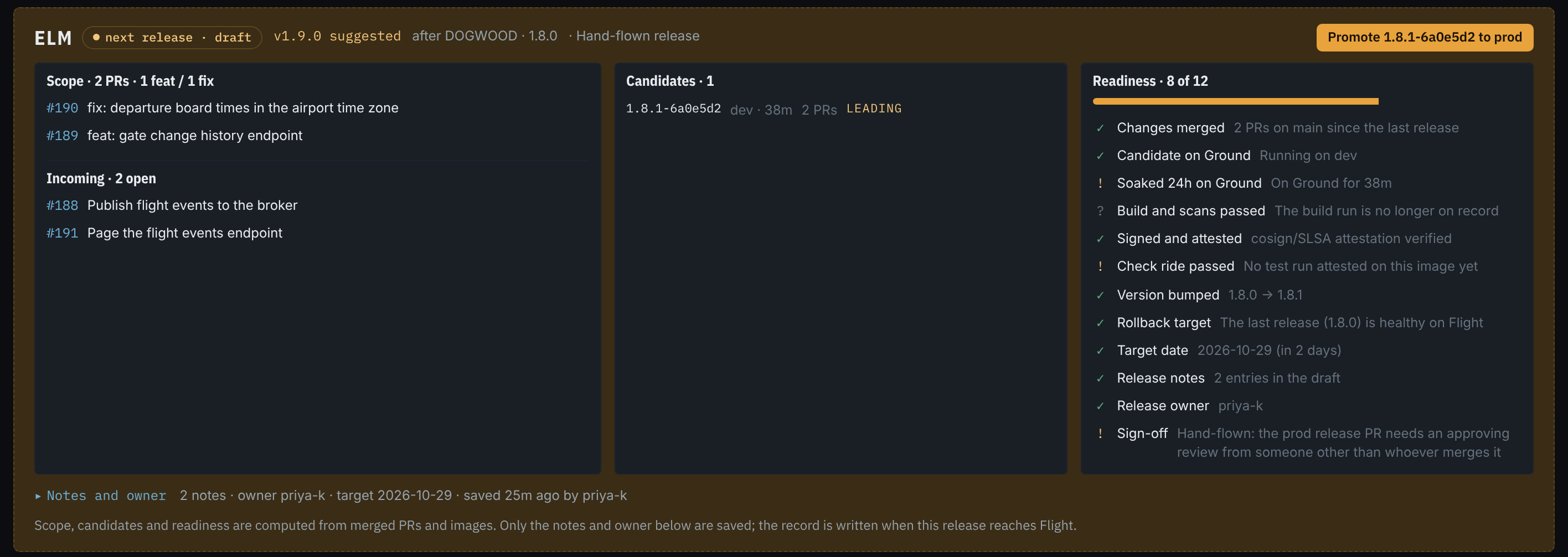
People write the rest, early. The one part a person types is the notes and the owner: a short summary, release notes in Keep a Changelog sections, known issues, how to roll back, and a risk level. A button fills empty sections from the merged PR titles. Saving makes a direct commit to one file in the app repo, which builds nothing:
# glidepath/releases/next.yaml, in the app repo
owner: priya-k
summary: The gate board shows each gate's change history, and the departure board stops mixing time zones.
notes:
  added:
    - Gate change history endpoint (#189)
  fixed:
    - Departure board times in the airport's own time zone (#190)
risk:
  level: low
  rollback: "Safe to roll back to 1.8.0: no schema change."
targetDate: "2026-10-29"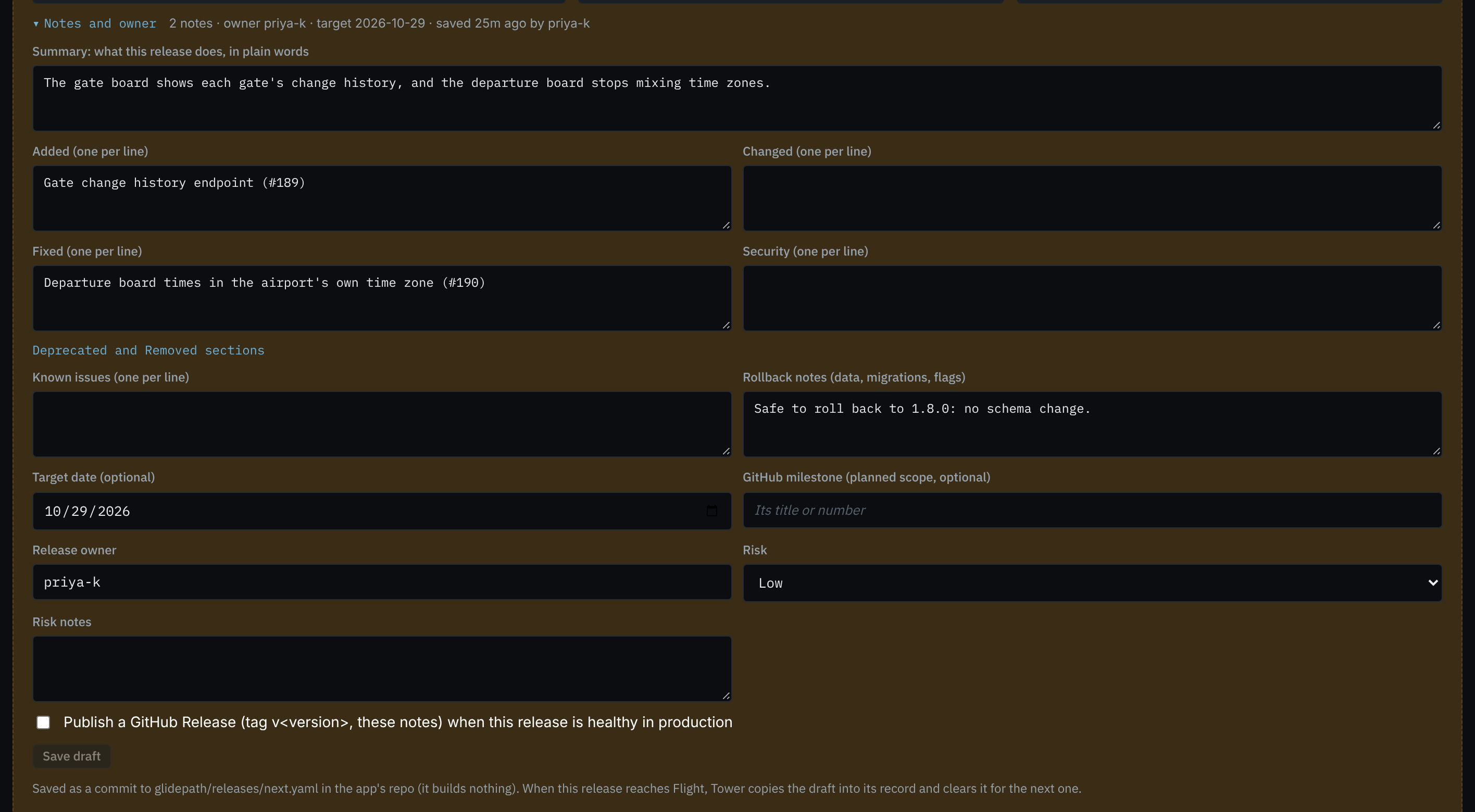
Sign-off moves onto the release PR. Promote sends the leading candidate through Glidepath's
normal release path, a pull request to the GitOps repo. What that PR needs depends on the app's release mode.
Assisted, the default, just records who merged and who reviewed. Hand-flown needs an approving review from one
of the app's owners or an admin, who isn't the person merging. GitHub's free plan can't require a check on a
private repo, so this is a soft gate: Tower sets a hangar/release-signoff status on the PR every
two minutes, and if it merges without a sign-off that counts, a high-severity notification says so and the
record says so forever. The modes themselves live in a platform-owned file, and changing one is a pull
request.
The record is sealed in git. Within a few minutes of the release being healthy in its first Flight environment, Tower opens a pull request adding the record to the app's GitOps repo. The draft is copied in and cleared for the next release. The evidence is frozen at the same time: every release gate's result, how the commit was proven, the check ride the qa gate read, and the change request if the app has one. Those sources don't last. Pipeline runs get pruned, and Glidepath sweeps its tracking records after 14 days. The record keeps saying what was true when it shipped.
# releases/flight-api@1.8.0-4f9c2ab.yaml, in gitops-flight-api
schemaVersion: 2
appName: flight-api
imageTag: 1.8.0-4f9c2ab
release:      # the draft above, the mode it shipped under, and the sign-off
guardrails:   # every release gate's result, frozen when the record was sealed
testEvidence: # the check ride the qa gate read, and whether it verified
changeRequest:
humanContext: # after release: how it was checked, follow-ups
outcome:      # added by a second pull request, once it is final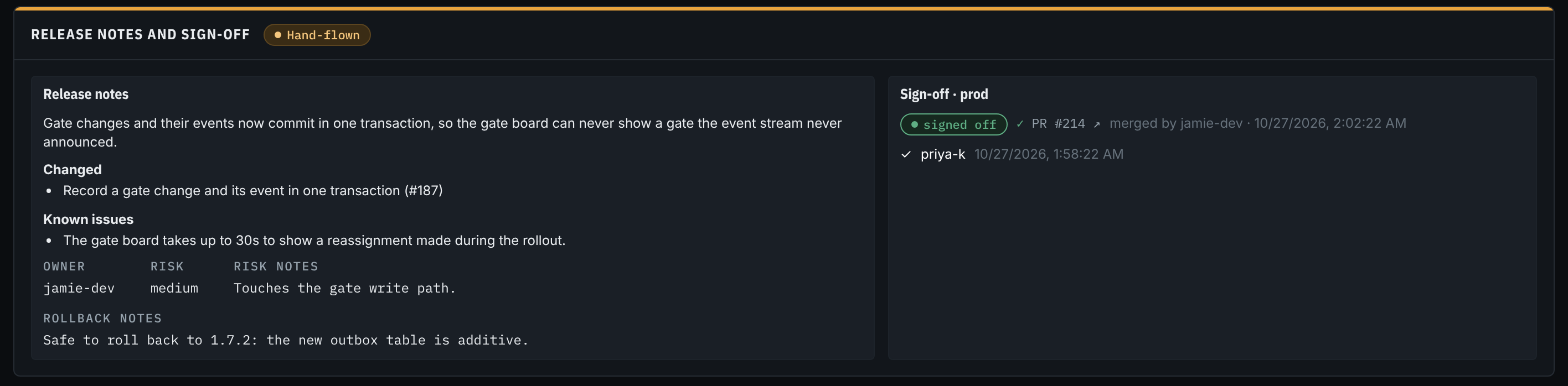
Then it waits to hear how it went. The record stays open through a seven-day bake in
production. Once the outcome is final, a second pull request writes it into the same file: clean, rolled back
(naming the release it rolled back to and why), replaced before it was healthy, or stopped before production.
After that, anyone can add what they checked in production, follow-ups and acknowledgements, through a pull
request to the record. Opt in, and Tower also publishes a GitHub Release named ELM · v1.9.0 with
the notes as its body.

Git gets every decision. The cluster keeps only what is still moving.
Store everything in git
The second of my principles is that every change is a reviewed commit, and the release record is that idea applied to a release's history rather than its config. The draft is a commit. The release mode is a pull request. The record is a pull request, and so is its outcome. Even the sign-off is a review on a pull request. Tower writes all of them through Backstage's backend and owns none of them.
Why go to that trouble when a database would be simpler? Because of who might need it, and when. If Tower were
deleted tomorrow, every release's story would still be in the repo, readable with nothing more than
git log. Each record is diffable, so comparing two releases is comparing two files. It sits right
next to the thing it describes: the GitOps repo that says what's deployed also says how it got there. An
auditor already knows how to read a git history and trusts it in a way they'd never trust a dashboard. And an
agent can read a YAML file without learning Tower's API. The readiness score is worked out only from what the
committed record carries, so a release scores the same in the list, in a comparison and when you open it.
It isn't everything, though, and I'd rather draw the line clearly than pretend. A release that's rolling out changes every few seconds. That state lives in a tracking record on the dev cluster, fed by the facts each Rollout posts (Glidepath's ADR-0021), because nobody should review a pull request every time a canary step moves. The draft's scope and candidates are computed and never saved. The bake is read live. The rule I've ended up with is that git gets every decision and every final answer, and the cluster keeps what is still moving. When it stops moving, Tower writes the end of the story into git.
There's a cost. One release can mean a commit and three pull requests, and on a busy team that's a lot of noise in a GitOps repo. Tower keeps record PRs out of the release gates, but whether real teams would find that history precious or annoying is another thing I don't know.
What it's trying to fix
Pulled together, these are the problems I built the release record to solve. Each one comes from releases I've lived through in my career, not from Hangar's users, because it hasn't got any.
Notes written the night before. The draft exists from the moment the last release ships and fills itself from merged work, so notes can grow as the release does.
Approvals that come after the fact. Sign-off sits on the release PR, before the merge, where it can still stop something.
Evidence that disappears. Gate results, commit proof, test evidence and the change request are frozen into a file that outlives the systems they came from.
"Which build was that?" A release has a name people can say. The image slug still says which build went out.
Scores that flatter. Readiness says how ready a release was when it shipped. The outcome says what happened next. They sit side by side and never get folded into one number, and the free "no incidents" points are gone.
Releases that end in silence. Every record gets an outcome, and a rollback says what it went back to and why.
Change management without a change board. An app that goes through change management gets its change request number and state on the record, beside a light peer sign-off. External approval boards slow delivery without lowering the change failure rate, which is one of the clearer findings in the DORA research, so I'd rather have the evidence travel with the release.
The guesses underneath
Here's the part I promised. Every one of those fixes rests on something I believe about how teams release software. I've written the main ones down, with what I built on each, and the test I'd run if I had a team to run it with.
Some of the numbers are pure judgment. Twenty-four hours on Ground before readiness is happy. A seven-day bake. Autoland eligibility at five recorded outcomes, under 15% rolled back and an average readiness of 80. They're sensible-sounding, and they're mine. Some of the design is taste: I like the tree names, and a real team might find them twee within a week. And some of it might be aimed at the wrong person entirely. I've assumed the release owner is the one who cares most, when it might really be the person on call, who just wants to know what changed in the last hour.
What I'm fairly sure of is the shape: a release is something with a lifecycle, and a deploy is just one event in it. Nearly every release tool I looked at for the spec has landed somewhere near that. Which parts of the lifecycle people actually care about is the bit I'd expect to be wrong.
What I'd do with real users
If I took this into a company tomorrow, I wouldn't roll it out to everyone. I'd find one team that releases often and sit beside them for a release or two, end to end, before showing them anything. Then I'd talk to each of the people in that second diagram on their own, the owner, the reviewer, whoever's on call and whoever does the audits, and ask what they looked for the last time a release went badly, and where they found it.
Then I'd measure, because interviews tell you what people think they do. Do notes exist before Promote, and does anyone change the pre-fill? How long is it between a sign-off and the merge, and is it ever under a minute? Does anyone open a record after its outcome is written? Does the export ever leave the building? Tower records none of that today, and it would be the first thing I'd add. Then I'd keep what's used, change what's used wrongly, and retire what nobody touches, even the parts I'm fond of.
And I'd keep going back. The release record I've built is my best guess at a first version, which means it's really a draft of the second one. The second one should be written with someone else.
What isn't built
A few things are missing, and they're on the record's own docs page as well. Autoland doesn't exist yet. The
inputs it would decide on are there now: the check ride is a real, signed test result, and canaries in
production are judged on the production cluster's own Prometheus metrics. What's missing is the decision
itself, and enough recorded outcomes to trust it. The bake doesn't read SLO burn yet either: the metrics are
there, but an outcome is still decided from the rollout alone, so "clean" doesn't yet mean "no burn". Tower has never tracked incidents, so an outcome
can say rolled back but not "caused a page". Outcomes depend on Glidepath's tracking records, so releases older
than 14 days and releases to cloud targets don't get one. Linked issues are only found through closing keywords
like Fixes #12. Announcements go to Tower's activity feed, not to chat. The full detail is in
Tower's release record docs.
Why I still like it
For all the guessing, I keep coming back to that YAML file. Software teams lose so much of their own history, and most of it isn't lost through carelessness. It's lost because the story was spread across tools that were each built to answer something else. Writing it down in one place, in git, as it happens, feels like a kindness to whoever comes next, even if that's just me in six months, wondering why a release was rolled back one Tuesday afternoon.
I'd love to find out which of my guesses are wrong. That would mean someone was using it.
James
Where Hangar does this, and where it doesn't yet
- Built A draft for the next release from the moment the last one ships, with scope, candidates, readiness and a suggested version
- Built Notes, owner and risk written before the release, saved as a commit to glidepath/releases/next.yaml
- Built Three release modes; Hand-flown sign-off on the release PR as a soft gate, with a notification when one ships without it
- Built The record sealed by a pull request to the app's gitops repo, with gates, commit proof, check ride and change request frozen in
- Built An outcome after a seven-day bake, written back by a second pull request: clean, rolled back, replaced or stopped
- Built The lifecycle spec behind it, R1 to R4 shipped in Tower v0.67 to v0.70 on October 13 and 14, 2026
- Built Rollout state from the Rollout's own facts, in a tracking record on the dev cluster (ADR-0021)
- Proposal Autoland: releases that reach production with no human
- Proposal SLO burn read during the bake window, so a clean outcome also means no burn
- Proposal Any measure of how people use the record, or any user but me