
Docs · Tower
Break-glass: admin guide
For the people who run the platform: what break-glass is made of, where each piece lives, how to set it up on a cluster, how to operate it, and why it is built the way it is. If you only use break-glass, the user guide is the place to start.
Start here
| Read | When you want to… |
|---|---|
| Architecture (below) | see every component and where it runs |
| Setup | enable break-glass on a cluster, step by step, and verify it |
| Configuration reference | look up a config key, an environment variable, a label, a limit or a permission |
| Admission policies | understand each policy rule on Ground and Flight, and change one safely |
| Operations runbook | handle a stuck session, a policy outage, a debug image release, an audit request |
| How it works | follow a session through the backend: states, routes, storage, transport, cleanup |
| Design decisions | know why exec is refused, why VAP on Flight, why one extension, and the build history |
| Testing and verification | prove a change against the real clusters without touching production |
Architecture
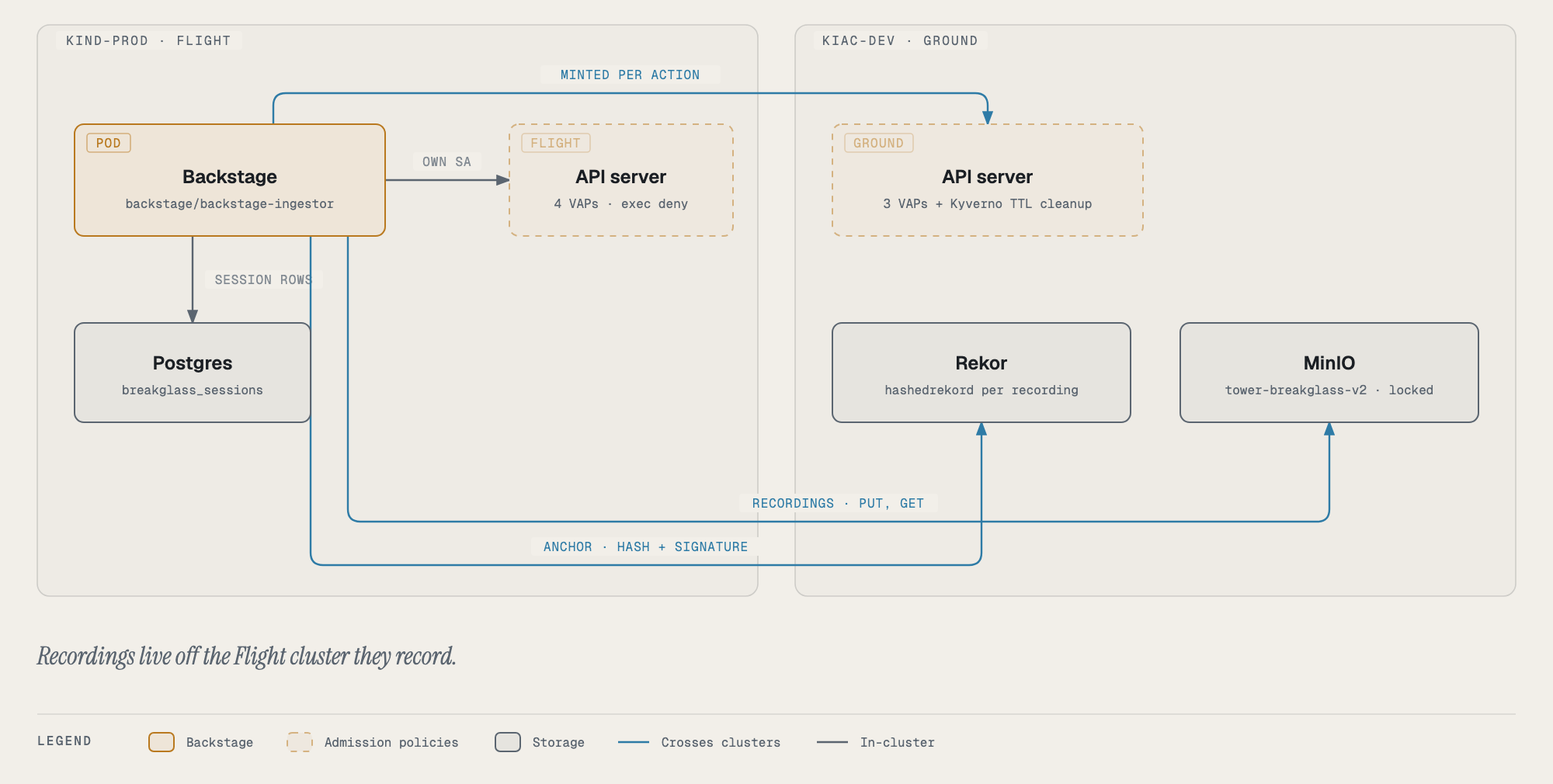
| Component | Where | What it does |
|---|---|---|
Tower UI (BreakglassPanel, BreakglassEnvironmentView, RecordingPlayer, breakglass/BreakglassQueueStrip) |
src/tabs/topology/ and src/breakglass/ |
the pod’s Debug panel (the form and its terminal); the environment’s Break-glass card (approvals, End, history, reviews, player; deep links); the home-page and Ops Wall queue strip |
Break-glass backend (breakglass.ts, breakglassSpec.ts, breakglassStore.ts) |
packages/backend/src/, mounted under the glidepath plugin at /api/glidepath/breakglass |
the routes, the session state machine, the grant and debug-container objects, the terminal relay, the recording, the sweep |
| Permissions | backstage towerPermissions.ts, permissionPolicy.ts |
tower.breakglass.request, .approve, .terminate (grant-only), .self (grant-only) |
| Session store | Backstage’s database (glidepath plugin), table breakglass_sessions |
one row per session: the audit record |
| Debug RBAC (per cluster) | gitops-cluster-dev 00-bootstrap/backstage-ingestor-rbac/breakglass-rbac.yaml; gitops-cluster-30-policy/breakglass/rbac.yaml |
the two debug ClusterRoles and Backstage’s standing binder right |
| Ground policies ( |
gitops-cluster-dev 30-policy/kyverno-policies/tower-breakglass.yaml (+ -rbac.yaml, -debug-image.yaml) |
four Kyverno ValidatingPolicy resources compiled into native ValidatingAdmissionPolicies (vpol-tower-breakglass-*), and one ImageValidatingPolicy (the debug image’s signature, a scoped webhook); Kyverno’s cleanup controller deletes expired grants and copy pods |
| Flight policies ( |
gitops-cluster-30-policy/breakglass/policies.yaml (Argo CD app tower-breakglass), 30-policy/kyverno + kyverno-policies |
five native ValidatingAdmissionPolicies, including the exec deny; a slim Kyverno (admission + cleanup controllers only) for the TTL backstop and the debug image’s signature |
| Recordings store | MinIO on tower-breakglass-v2 (40-observability/minio/create-breakglass-locked-bucket-job.yaml; the first bucket keeps older recordings) |
one asciicast per session as versions in an object-locked bucket (governance, 365 days), 365-day lifecycle; Backstage’s key may put and get only; each hash anchored in Rekor |
| Recordings credentials | Infisical (tower-breakglass-minio-access-key, -secret-key) → ExternalSecret backstage-breakglass-minio → env TOWER_BREAKGLASS_MINIO_* |
planted by hand, never generated |
| Debug image | debug-image/ + .github/workflows/debug-image.yml → ghcr.io/<owner>/tower-debug |
Alpine with the debugging tools; amd64 + arm64; signed with cosign; pinned by digest in three places |
Identities
Backstage’s identity on each cluster is learned at run time with a SelfSubjectReview (cached per cluster), so the
grant’s subject is always whoever Backstage really is there:
| Cluster | Tier | Backstage’s identity | Grant subject |
|---|---|---|---|
<dev-cluster> (the same name in Backstage’s config) |
Ground | hangar:<prod-cluster>:tower-actor, a token minted per step (Cluster credentials) |
kind: User |
| Flight | system:serviceaccount:backstage:backstage-ingestor, in-cluster |
kind: ServiceAccount |
Both clusters’ policies name these usernames literally. A new cluster needs its own (see Setup). On
What Backstage can do on a cluster
| At rest | During a session (in that one namespace) | |
|---|---|---|
| Create/delete RoleBindings | yes, but only binding tower-breakglass-debug-live or -copy (RBAC bind by resourceNames; the policy narrows it to itself, app namespaces, and a TTL) |
same |
| Read pods | as its existing read access allows | get, list |
| Add an ephemeral container | no | live mode: pods/ephemeralcontainers patch/update (the image and settings checked by policy) |
| Create a pod | no | copy mode: create (only a hardened, labelled copy, by policy) |
| Delete a pod | no | yes, but the policy allows only a pod carrying a debug-* container or a copy pod |
| Attach | no | pods/attach create (on Flight, only to a debug-* container, by policy) |
| Exec | no | no (on Flight refused by policy even to a session) |
Ground and Flight, side by side
| Ground ( |
Flight ( |
|
|---|---|---|
| Approval | none | a second person, or glass broken (admins) |
| Policy engine | Kyverno ValidatingPolicy → generated VAP |
hand-written VAP + bindings; a slim Kyverno (admission + cleanup only) for what a VAP cannot do |
| Exec deny | not enforced (Tower never offers exec) | tower-breakglass-no-exec |
| Approver annotation required | no | yes, or hangar.io/breakglass-glass-broken: "true" |
| TTL backstop | Kyverno cleanup controller | Kyverno cleanup controller (slim install, phase D); plus Backstage’s sweep on both |
| Image signature checked at admission | yes: tower-breakglass-debug-image (cosign keyless, tower’s debug-image workflow) |
yes, the same policy |
| Process access enforced in the cluster | yes: the pod’s hangar.io/breakglass-process-access annotation must name the session (G14) |
yes, the same rule |
| Last ready pod recycled | if the requester asked | never |
Known gaps and their planned fixes are tracked in the platform’s break-glass gaps spec; the user-facing ones are listed in Guardrails.