
Docs · Glidepath
Release state
Every release to an upper-cluster environment has a record on the dev cluster that says where the release is: proposed, merged, rolling out, healthy, failed, superseded. The record is what turns a stream of low-level facts from the prod cluster (a Rollout changed phase, a sync failed) into the release events the rest of Glidepath consumes, and it is what lets the platform tell a release from a scale, a restart or a manual edit.
This page is the reference. The decision and its history are in ADR-0021 (with the phase 0 findings and phase 1 results); the event vocabulary is ADR-0022.
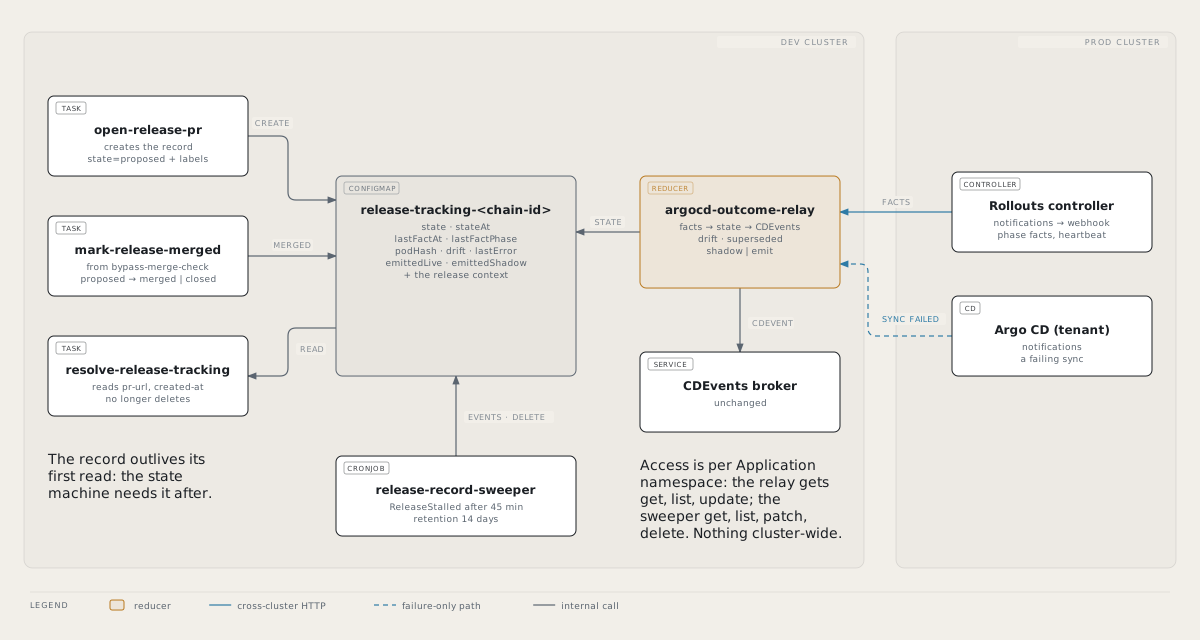
The record
One ConfigMap per release, release-tracking-<chain-id>, in the Application’s own namespace
(app-<name>-cicd) on the dev cluster. Labels: hangar.io/subcomponent=release-tracking,
hangar.io/app, hangar.io/env, hangar.io/cluster. The release is identified by
releaseId, <chain-id>:<cluster>/<env>, which also rides on the Rollout as the
hangar.io/release-id annotation so a fact can be joined to its record.
| Key | Written by | Meaning |
|---|---|---|
prUrl, prCreatedAt |
open-release-pr |
The gitops release PR and when it opened. |
releaseId, kind |
open-release-pr |
The release’s identity; promote, or rollback (ADR-0021 phase 4). |
image |
open-release-pr |
The image the release deploys. Rollback eligibility matches on it; records written before phase 4 have none and never qualify. |
rollbackOf, rollbackReason |
open-release-pr |
A rollback only: the release-id it replaces, and why. |
appNamespace, appName, env, cluster |
open-release-pr |
What was released and where. |
gitUrl, gitRevision, flowStartTime, configJson |
open-release-pr |
The context the outcome events and the lead-time anchor need. |
state, stateAt |
open-release-pr (proposed), mark-release-merged (merged, closed), the relay (everything after) |
Where the release is, and since when. |
mergedAt |
mark-release-merged |
When the PR merged, recorded whatever state the release is in (Argo CD and the Rollout can start faster than the Task does, so the record may already be progressing: seen live). The stall alert’s clock for a merged release, and the merge-to-deploy latency. |
lastFactAt, lastFactPhase |
relay | The last fact that arrived for this release. The stall alert’s clock for a progressing release. |
podHash |
relay | The pod template hash of the release’s first fact. A different hash later is drift. |
drift |
relay | The last drift description, if any. |
lastError |
relay | The last Argo CD sync error for this release. |
emittedLive, emittedShadow |
relay | The CDEvent kinds already sent, per mode (below). |
supersededBy |
relay | The release that replaced this one. |
healthyAt |
relay | When the release first reached healthy. Kept through superseded and rolled-back: “this image ran healthy here” is what rollback eligibility reads. |
rolledBackBy |
relay | The rollback release that replaced this one. |
changeRequestId, changeRequestNumber, changeRequestUrl |
open-release-pr |
The release’s change request in the change tool (change-management.md); empty without a provider. |
changeRequestState, changeRequestApproval, rolledBackByChange |
itsm-gate, itsm-change |
The change as last seen by the gate, then implementing, implementing-failed, closed-successful or closed-unsuccessful (with the rollback’s emergency change). |
clearanceId, clearanceTree |
clearance-gate (G-ARGO-6) |
The Clearance change the release’s PR was registered as, and the manifest-tree digest it was registered for. Written right after POST /v1/clearances answers; absent for a release to an unprotected environment. GET /v1/apps/{app}/releases/{chainId} returns them as clearance: {id, tree}, and release-log-emit copies them into the release log as clearance_id and clearance_tree. |
label hangar.io/stall-alerted |
sweeper | The state a ReleaseStalled Event was already raised for. |
The record is not deleted when its outcome is read (it used to be). The state machine needs it afterwards, and the sweeper removes it past its retention.
Outside Glidepath, Tower’s backend reads the records (list with the labels above, as its
read identity on the dev cluster) for three things: the releases a rollback may target, the
images an image prune must keep, and each release record’s outcome (clean, rolled back,
replaced before healthy, stopped before production), from state, healthyAt,
supersededBy, rolledBackBy, rollbackReason and image. Tower writes the outcome into
the release record in gitops-<app> once it is final, so it outlives the sweep; a release
whose records were swept first, or written before phase 4 (no image), has no outcome. See
Tower’s docs/release-records/index.md.
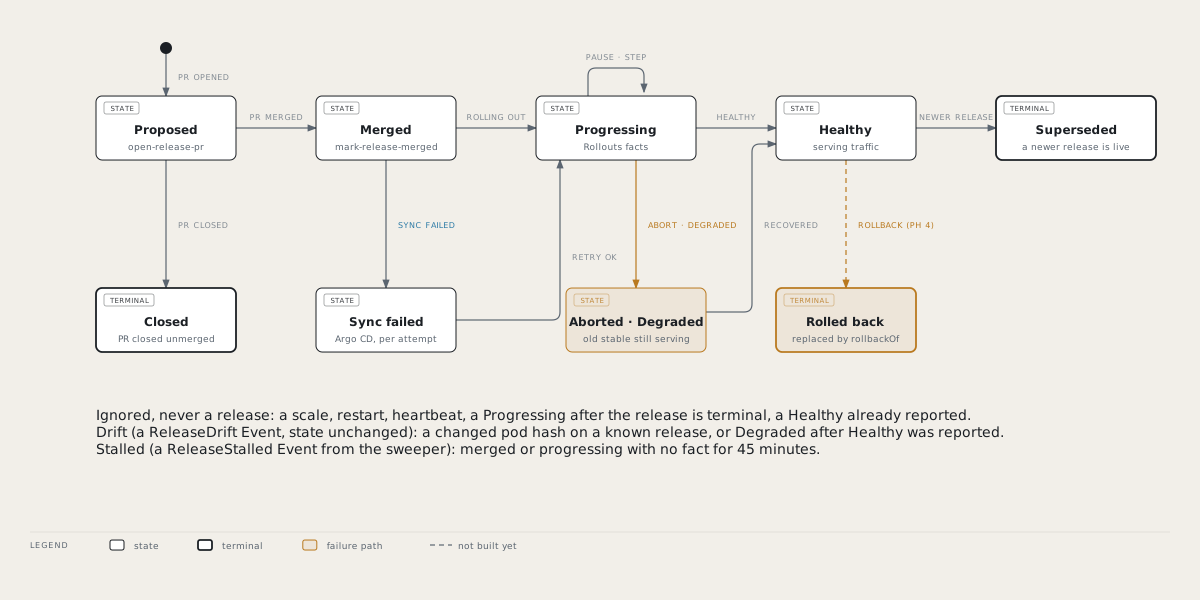
The state machine
| Move | Caused by | Written by |
|---|---|---|
(new) → proposed |
The release PR opens | open-release-pr (also for Tower’s Promote, see below) |
proposed → merged |
The gitops PR merges | mark-release-merged, run by bypass-merge-check, which is triggered by the push to main the merge produces (resolve-merged-pr turns the pushed commit back into the PR number; a push that is not a PR merge skips it). It only moves proposed (or a record with no state), never a state the relay owns. |
merged → progressing |
The Rollout reports Progressing or Paused |
relay |
merged → sync-failed |
Argo CD reports a failing sync | relay |
sync-failed → progressing |
Argo’s retry succeeded and the Rollout reports | relay |
progressing → healthy |
The Rollout reports Healthy |
relay |
progressing → aborted / degraded |
The Rollout reports Degraded (aborted if the abort flag is set) |
relay |
aborted / degraded → healthy |
The Rollout recovers | relay |
aborted → progressing |
Tower’s Retry: a Progressing fact with the abort flag clear (no second deploying event; a later Healthy reports success, another abort goes back to aborted) |
relay |
healthy → superseded |
A newer release of the same app, environment and cluster reports its first fact | relay |
any ran state → rolled-back |
A rollback release naming this one in rollbackOf turns healthy; one service.rolledback event is sent. Only a release of the same app, environment and cluster can be marked. |
relay |
Tower’s Promote to a Flight environment runs the same release Pipeline, from the
promote-release TriggerTemplate glidepath-app renders into each Kubernetes app’s -cicd
namespace; Backstage fills its params and creates the PipelineRun. Until 2026-10-08 the
Backstage backend opened the release PR itself and wrote no record, so the relay dropped every
fact for a Tower-promoted release as no-record.
sync-failed is not terminal. healthy, aborted, degraded, superseded, rolled-back
and closed are.
What a fact does
Facts are at-most-once and arrive repeated, out of order, and describing things that are not
releases (all of it observed on a real release). The reducer (reducer.go, a pure function, so
every row below is a plain test) handles it like this:
| Fact | Result |
|---|---|
First Progressing or Paused for a release |
State progressing; one environment.deploying event. |
Further Progressing, Paused, or a heartbeat |
Nothing. |
Healthy |
State healthy; one environment.deployed (success) event. A repeat, or a heartbeat, emits nothing. |
Degraded |
State aborted or degraded; one environment.deployed (failure) event. |
The first fact seen is already Healthy or Degraded |
The deploying event that was lost before it is sent first, then the outcome. |
Progressing after the release is terminal |
Ignored (Phase 1 saw one arrive in the same second as Healthy). |
| Same release-id, different pod template hash | Drift: a ReleaseDrift Event on the record, state unchanged, no CDEvent. A manual edit, or an undo that selfHeal has not yet reverted. A scale, a restart or a heartbeat keep the hash, so they are not drift and not releases. |
Degraded after Healthy was already reported |
Drift, not a failed deploy: the workload failed after a good release. |
| An Argo CD sync failure on a merged, progressing or sync-failed release | State sync-failed; deploying and a failure event, once per release however many retries. |
An Argo CD sync failure with no such release in flight (a hand edit to values.yaml) |
Ignored. |
| A release’s first fact, while an older release of the same app, environment and cluster is live | The older one becomes superseded (best effort). |
The pod template hash is deterministic for a given template, but it is not an identity for “the same image”: rolling back to an earlier image can produce a different hash. The release-id, not the hash, identifies a release.
How a fact is applied
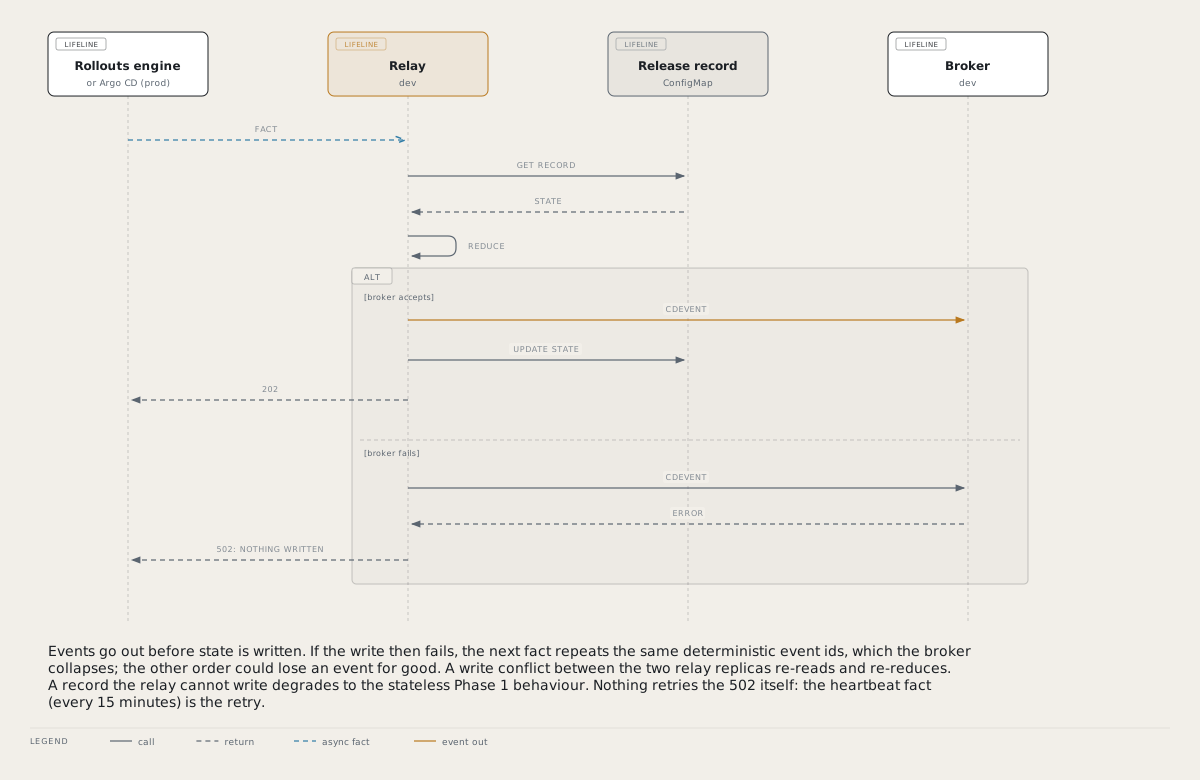
- Events go out before state is written. If the write then fails, the next fact repeats the same deterministic event ids (derived from the release-id, event type and outcome), which the broker’s Triggers collapse. The other order could lose an event for good.
- A failed forward returns 502 and writes nothing. The sender does not retry, but the Rollouts engine re-sends current state every 15 minutes (its heartbeat), so the retry is the next heartbeat. Rollouts notifications are at-most-once and fail silently (phase 0); the heartbeat, and the prune CronJob that resets the engine’s own state, are what make the stream recover.
- A write conflict re-reads and re-reduces. There are two relay replicas.
- A record the relay cannot write (no Role yet, or it vanished) degrades to the stateless behaviour of phase 1: the deterministic ids still make repeats harmless.
- The hook Jobs are gone (phase 3b/3c). While both ran, emit mode dropped the hook Jobs’
copy of an event when the facts owned the release, and forwarded it as a fallback when they
had not; that code, the
/outcomeendpoint and the hook script were deleted with the Jobs. A release whose facts are lost now waits for the next heartbeat (15 minutes), and the sweeper raisesReleaseStalledif none arrives. - Shadow and emit keep separate sent-sets (
emittedShadow,emittedLive). Inshadow(opt-in;outcomeRelay.factsModedefaults toemit) the relay logs the event it would send asshadow-eventand forwards nothing. Flipping toemitthen sends the history instead of believing shadow already did.
The two sources
Rollouts notifications (POST /facts/<cluster>) |
Argo CD notifications (POST /argocd/<cluster>) |
|
|---|---|---|
| Reports | A tracked Rollout’s phase, step and pod hash | A tenant Application’s failing sync |
| Fires | On each phase change, plus a heartbeat every 15 minutes | On the first failed attempt (retryCount > 0) and on the final failure |
| Why | The Rollout is where the release’s meaning lives | The Rollout never sees a sync rejected before it changes |
| Joined by | hangar.io/release-id on the Rollout |
hangar.io/app and hangar.io/env labels, newest in-flight release |
Tenant Applications retry (limit 5, backoff up to 10 minutes), about 15 minutes to a final
Failed, and operationState.phase stays Running through the retries. A trigger on
phase == Failed alone would be 15 minutes late, which is why the first failed attempt fires.
Stalls and retention
release-record-sweeper (control plane, every 10 minutes):
- raises a
ReleaseStalledEvent on a record that ismergedwith no fact for 45 minutes (the sync never started, or facts are not arriving), orprogressingwith no fact for 45 minutes (the heartbeat arrives every 15), once per state; - deletes records past 14 days: terminal and closed records by
stateAt, proposed and state-less legacy records by creation time. Amergedorprogressingrecord is never swept, and neither are the newest five records per app, environment and cluster that reachedhealthy(the rollback-eligibility window, below).
The knobs are env vars on the CronJob (RELEASE_STALL_MINUTES, RECORD_TTL_DAYS, KEEP_HEALTHY).
Rollback (ADR-0021 phase 4)
A rollback is a release of an earlier image: Tower’s Roll back starts the app’s
rollback-release TriggerTemplate (glidepath-app), the same release Pipeline as Promote with
release-kind: rollback, rollback-of and rollback-reason, and config-revision so
cicd.yaml is read at the app repo’s main while provenance still checks the image’s own
commit. open-release-pr records the kind, opens branch release-rollback-<env>-<sha8> and titles
the PR Rollback:.
The content gates (sast, image-scan, sbom) work out for themselves whether the promoted
image is an eligible rollback target: extract-promoted-image’s rollback-eligibility step
reads this app/environment/cluster’s records and answers yes when one of the newest five that
reached healthy ran the same image. Then the gate runs its check as <task>-advisory with
onError: continue: the check run passes and the PR comment shows what it found. Integrity
gates (provenance, values, commit signing) and approvals are unchanged. The PR’s own text and
trailers are never trusted for this.
Permissions
Per Application namespace (glidepath-app, identity/release-record-relay.yaml), not
cluster-wide:
| Identity | Verbs on ConfigMaps in app-<name>-cicd |
Also |
|---|---|---|
glidepath-relay (platform-system) |
get, list, update | create Events |
release-record-sweeper (platform-system) |
get, list, patch, delete | create Events |
pipeline-runner (the Tekton tasks) |
get, list, create, patch, delete (list added for mark-release-merged) |
The relay’s cluster-wide get on ConfigMaps from phase 1 (glidepath-relay-records)
remains until every namespace has the Role, then goes. The two infra apps (skyport-auth,
skyport-broker) have no release flow and no Role; the relay and sweeper skip them.
Operating it
# every release's state, newest last
kubectl get cm -A -l hangar.io/subcomponent=release-tracking \
  -o custom-columns=NS:.metadata.namespace,NAME:.metadata.name,STATE:.data.state,SINCE:.data.stateAt,LAST_FACT:.data.lastFactAt

# one release in full
kubectl -n app-gate-api-cicd get cm release-tracking-<chain-id> -o yaml

# drift and stalls
kubectl get events -A --field-selector reason=ReleaseDrift
kubectl get events -A --field-selector reason=ReleaseStalled

# what the relay would send, if factsMode is shadow
kubectl -n platform-system logs -l app=glidepath-relay --prefix | grep shadow-event
Tests
glidepath/broker:go test ./cmd/glidepath-relay. The reducer’s rows above, state persistence, a failed forward, a write conflict, an unwritable record, drift, supersede, shadow-then-emit, and the Argo CD endpoint.charts/glidepath-catalog/tests/mark_release_merged_test.sh,charts/glidepath-catalog/tests/rollback_eligibility_test.shandcharts/glidepath-control-plane/tests/release_record_sweeper_test.shrun the real Task and sweeper scripts against a stubkubectl.
Not built yet
Moving the events onto the spec’s vocabulary (ADR-0022). Recording on the release that a Tower Promote full skipped analysis (Backstage audits and announces it; the fact carries no such field yet).
A PR closed without merging
The merge signal is the push to main, and an unmerged close produces no push, so mark-release-merged
never sees one. Instead, when open-release-pr opens a new release PR, it closes out the earlier
proposed records of the same app, environment and cluster (close_stale_proposals): each whose PR
GitHub reports closed and unmerged becomes closed. A record still open, merged, or unreadable is left
alone, and this never fails the release. That covers the common case, a release replaced by a newer
one (2026-10-30: five such records made Tower’s Ops Wall show releases awaiting approval whose PRs were
long closed). A PR closed with no later release of that environment still stays proposed until
retention deletes it (14 days).
Live verification (2026-10-06)
Every scenario above was exercised against the real clusters, not only in unit tests: real
gate-api releases on prod, and a synthetic Application namespace on dev driven
through the relay’s real endpoints (with the real mark-release-merged Task and the real
sweeper CronJob).
| Scenario | How | Result |
|---|---|---|
Merge marker, three cases (proposed, already progressing, already has mergedAt) |
real Task run via the cluster resolver | merged + mergedAt; mergedAt only; untouched |
Happy path with noise: repeated Progressing, Paused, Healthy, scale facts, heartbeats |
synthetic facts | one deploying + one success, nothing more; state healthy |
Late Progressing after Healthy |
synthetic | ignored, reported in the response header |
| Scale, then restart, on a real healthy release | real Rollout on prod | no CDEvent, no drift, state unchanged |
| Pod template edited by hand | real Rollout on prod | ReleaseDrift Event naming old -> new hash, state unchanged, no CDEvent. Raised 9 Events from one edit (fixed: once per change) |
Degraded after Healthy reported |
synthetic | drift, no failure event |
| Abort, repeats, then recovery | synthetic | state aborted, one failure; recovery sends the success |
First fact is already Healthy |
synthetic | deploying sent first, then success |
| Newer release | real gate-api release, and synthetic with older/newer/unmerged neighbours | older live one superseded with supersededBy; an unmerged proposal and a newer record left alone; a superseded release’s further facts send nothing |
| Rejected or ignored requests | synthetic | bad token 401; untracked, stale generation, unknown record, a namespace outside app-* all 202 and ignored; another cluster’s release-id, a malformed id, and an env that differs from the record all 400 |
| Argo CD sync failure, first attempt through final failure | synthetic, through /argocd/<cluster> |
sync-failed, one deploying + one failure however many retries, lastError kept; the Rollout then recovers it to healthy with the success sent; an unmerged proposal, another env, unlabelled apps and a healthy release are ignored |
| Stall alert and retention | real sweeper CronJob run | merged 2 h with no fact and progressing 90 min silent raise ReleaseStalled once; a recent progressing release does not; a healthy record past 14 days is deleted; a merged record is never swept; a second run raises nothing new |
| Prune CronJob | real, on prod | the Rollout’s notified annotation went from 90 keys to 4, the engine resent state at once, no CDEvent, state unchanged, Argo CD still Synced |
| A namespace the relay has no Role in | synthetic | fact accepted, events still produced, a log line says it did not persist |
Not exercised live: a forward failure and the 502 retry (needs emit mode, unit-tested), a
write conflict between the two relay replicas (unit-tested), and a PR closed unmerged with no later
release (the gap above; close_stale_proposals is covered by its script test). The retention of proposed and state-less legacy records is covered by the
sweeper’s script test, because a record’s creation time cannot be back-dated.